Published: August 2st, 2026 Est. |⏱️~10 minutes
By Dusty Rhoades
In tropical and subtropical coastal areas, screen enclosures have one seemingly simple job: keeping insects out of living spaces.
But when squall lines or tropical cyclones roll through, the first parts to fail aren't the windward walls. It's the roof and the leeward side. They aren't pushed in—they're sucked outward by a force from inside.
Over the past decade or so, working from Florida's squall corridor to waterfront communities in other climate zones, I've seen the same blind spot again and again: people focus on wind pressure pushing inward, but seriously underestimate how quickly wind suction can cause a chain reaction of damage.
This article uses Florida squall-line tests as a benchmark. It breaks down how screen enclosures actually fail, and explains why wind-suction design—not just pest control—is the baseline for survival in a storm.
1. Wind Thrust vs. Wind Suction: Two Different Failure Mechanisms
Most people picture wind damage as a force that pushes a structure inward. That's wind thrust, or positive pressure.
But for screen enclosures, the primary cause of failure during squalls or tropical storms is wind suction—negative pressure.
When high-speed wind rushes over the roof and outer walls, the outside air pressure drops quickly. Inside the enclosure, the pressure stays relatively normal. That difference creates an upward and outward pull.
It works like an airplane wing. The faster the airflow, the lower the pressure, and the stronger the lift. The roof of a screen enclosure behaves like a thin panel trying to take off. Meanwhile, the leeward walls get pulled outward.
That's why the Florida Building Code (2023) requires that screen enclosures be designed for wind loads in all directions: inward, outward, upward, and downward. The same principle applies in other regions with similar wind-load codes—parts of the Caribbean, Australia (AS 1170.2), and coastal areas following the International Building Code.
2. Key Findings from Squall-Line Tests: Failure Happens Much Earlier Than Expected
To understand how screen enclosures perform in real storms, the Florida Building Commission commissioned a full-scale structural test. It was called "Full Scale Wind Load Testing of Aluminum Screen Enclosures" (Project PO A95F33). The work was carried out by Florida State University and the University of Florida between January and June 2014.
The test report found that screens began to fail at 80 mph. Some 2×1 screen attachments failed between 90 and 100 mph. And importantly, these failures happened even though the actual test loads were lower than the code-required design values at the time.
80 mph (about 130 km/h) is only a strong tropical storm or a severe squall. It's far below major hurricane strength. Damage always appeared first on the leeward side and at roof connections.
The report also noted that without tension cables, the moments on connections increase sharply, leading to pull-out failures.
As for my personal field experiences—helping residents in places like Sebastian Inlet, Cape Coral, and Pine Island—these are firsthand accounts and cannot be independently verified from public sources.
3. The Code's Critical Thresholds: 75 mph and Porosity Ratings
The Florida Building Code sets a vital operational limit: when forecast winds exceed 75 mph (about 120 km/h), removable screen panels must be fully removed, retracted, or cut out.
This isn't a suggestion. It's a safety line. The logic is that ordinary screen mesh can't hold up against wind suction above that speed. The code assumes the screen will be sacrificed—so you remove it early to save the frame.
Beyond that wind threshold, the code also differentiates wind-load requirements based on the screen's open-area ratio (porosity):
Less than 40% open area (fine mesh): supporting members must resist 30 psf wind load.
More than 60% open area (coarse mesh): requirement drops to 10 psf.
Why does a denser screen need stronger support? Because it acts like a solid sail. It catches more wind and suffers both thrust and suction forces.
So when you choose screen mesh for a humid coastal home, don't just ask if it keeps out no-see-ums and sand flies. You also have to weigh how its porosity affects wind loads. Sometimes you have to compromise between bug protection and wind safety—or install a quick-release system so you can take the screens down before a squall hits.
4. Failure Modes and Repair Costs
Repair costs for storm-damaged screen enclosures vary widely, based on public price ranges from Southwest Florida pool-cage contractors.
A full rescreen typically runs between $1,200 and $3,500. Larger or more complex enclosures can go above $5,000. Multi-level rescreens may cost $4,500 to $8,500.
If the damage includes bent frames, replaced columns, and re-anchoring, the price climbs further. And if the foundation anchors are compromised—cracked concrete slabs, pulled-out bolts—you'll need to cut and repour concrete anchor points, which adds significantly to the bill.
On the insurance side, most Florida homeowners policies classify screen enclosures as "Other Structures" (Coverage B). The limit is typically set at about 10% of the dwelling coverage (Coverage A). In other cyclone-prone regions—like parts of the Caribbean or Australia—the fine print on storm endorsements and deductibles can also catch you off guard.
5. High-Performance Certified Wind-Resistant Products
There are now screen products designed specifically for hurricane-level wind suction. They go through rigorous wind-tunnel testing.
According to manufacturer literature, one example uses Honeywell's Spectra fiber and has been tested to withstand 155 mph winds and large-missile impacts, meeting Florida Building Code Wind Zone 4 requirements at the time of testing. However, those published reports are over a decade old, and current certification status should be verified directly with the manufacturer or through the Florida Building Commission's product approval directory.
Products like these typically undergo TAS 203 cyclic pressure testing—4,500 cycles in both positive and negative directions—plus ASTM E1886 impact and cyclic differential pressure testing.
They cost significantly more than standard insect screens, and they are fundamentally different from traditional lightweight enclosures. In other countries with similar standards (e.g., Australia's AS 1170.2), you can find certified products based on the same testing logic. The key question to ask: "Has this product passed cyclic negative-pressure testing?"
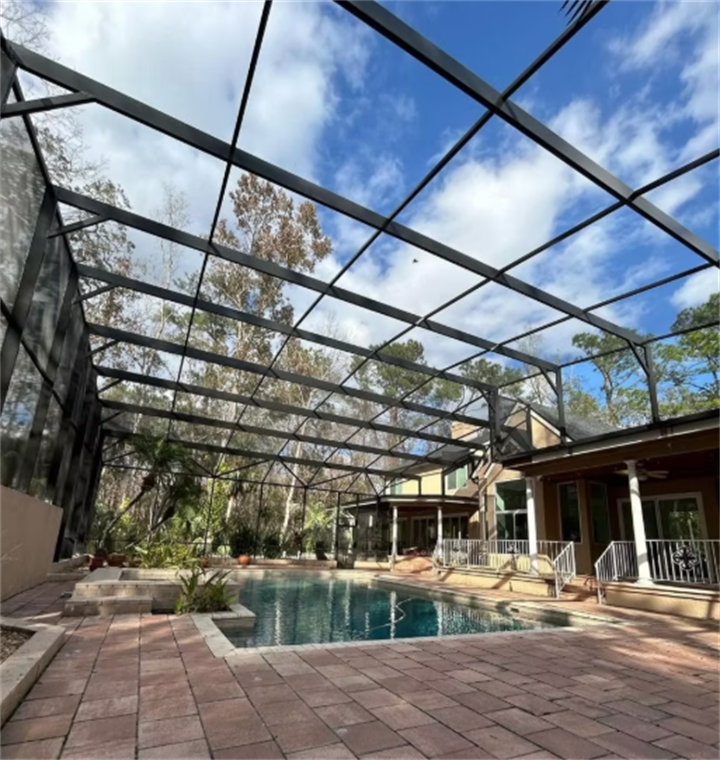
6. Core Strategy: Redirect, Don't Resist
In the end, the survival test for a screen enclosure in a tropical storm zone isn't about everyday bug protection. It's about wind suction performance under extreme conditions.
Bugs cause itching. Wind suction can turn your entire enclosure into a pile of aluminum debris that smashes into your windows.
Years of on-site experience point to the same conclusion: when the wind comes, the screen doesn't have to be the hero. You have two practical paths. Either remove the screen before the storm to protect the frame. Or, from day one, install an anchoring system that has passed cyclic negative-pressure testing and can stand up to sustained suction forces.
No matter which country you're in or which wind zone you live in, the standard for your screen enclosure should be based on local weather data and the building code's wind map—not pretty photos on social media, and not someone's backyard experience from inland areas.
FAQs
Q: Why does a seemingly solid screen enclosure still get lifted by wind suction?
A: Most people think of "strong" in terms of gravity and horizontal thrust. Wind suction creates an upward uplift force that acts on the entire roof and leeward walls. It tries to pull the structure right out of its anchors. Many older enclosures were only designed for horizontal pressure, not upward pull. Once the connections, anchor bolts, or tension cables can't handle it, the whole thing fails like a cork popping out of a bottle.
Q: What should I do with my screen enclosure during a squall or tropical storm warning?
A: If you have removable panels and the forecast wind speed may exceed 75 mph (about 120 km/h), the safest move is to take them down or cut them out ahead of time. This lets the wind flow through the frame. Before you do anything, make sure the aluminum frame's tension cables and anchor points are in good shape. Never climb on the structure during an approaching storm. If you're unsure, call a professional well in advance.
Q: Are high-end hurricane-rated screen products worth the investment?
A: That depends on your location and budget. If your home is on a coastline, near an inlet, or along an open lake shore—and you get frequent squalls or tropical cyclones—then a high-strength system that has passed TAS 203, ASTM E1886, or an equivalent international cyclic-pressure test can save you big repair costs after a storm. On the other hand, if your property is well sheltered and you can reliably remove screens manually before storms, a conventional system with proper operation may be a cost-effective choice.
Q: Is a more porous screen always safer? Should I just pick the coarsest mesh?
A: Not necessarily. A porosity above 60% lowers the wind load (to 10 psf on supporting members). But it also stops keeping out small insects like no-see-ums and sand flies. If the mesh is too coarse, you lose the whole point of having an enclosure. You need to balance pest pressure, wind-zone requirements, and your own tolerance—and make sure the anchoring system can handle the design load for the mesh you choose.
Disclaimer
This article is based on the author's personal field experience across different climate zones, as well as publicly available technical documents and code provisions. It is intended for general educational purposes only and does not constitute professional engineering or insurance advice. Local microclimates, soil conditions, and building regulations vary greatly. Before designing, modifying, or taking emergency action on any screen enclosure in a hurricane- or squall-prone area, always consult a licensed structural engineer and follow your local building code and official emergency guidelines.
References
[1] Florida Building Commission. (2014). Full Scale Wind Load Testing of Aluminum Screen Enclosures (Project PO A95F33, Draft Final Report). Florida Department of Business and Professional Regulation.
[2] Florida Building Code. (2023). Section 1609: Wind loads; Section 2002.4: Loads—Screen enclosures. International Code Council.
[3] Florida Building Commission. Rule 61G20-1.002: Alternative Design Method for Screen Enclosure.
[4] American Society of Civil Engineers. (2022). Minimum design loads and associated criteria for buildings and other structures (ASCE/SEI 7-22).
[5] Florida Building Code Test Protocols. TAS 203: Criteria for testing products subject to cyclic wind pressure loading; ASTM E1886: Standard test method for performance of exterior windows, curtain walls, doors, and impact protective systems impacted by missile(s) and exposed to cyclic pressure differentials.
About the author:
Dusty Rhoades
Builder without a fixed address. Over the past decade, he has constructed from the hurricane-prone coast of Florida all the way to the permafrost of Alaska, building outdoor facilities and providing accommodation and meals for farms, towns, and national parks. He only recommends materials that have survived a snowstorm or an entire rainy season right in front of his eyes. His advice is: "Your postal code is more authoritative than any design magazine."
Recommend:
Carving Out a Private Hot Tub Corner Overlooked by a Two-Story Neighbor
The Vanishing "Room" in Open-Plan Homes: A Bug-Proof, Breezy Screened Dining Porch
Creating a Backyard Oasis in Phoenix That Won’t Burn Your Feet – A Material Guide
Soapstone vs. Granite vs. Concrete for Outdoor Countertops: Stains, Cracks, and 10-Year Ownership Costs