Published: July 21, 2026| ⏱️10 minutes
By Clara M.
Here’s a quiet truth most people overlook: a septic mound isn’t a flaw in your yard. It’s simply part of the land’s shape. Across North America, Europe, Australia, and countless rural and suburban pockets of the world, plenty of backyards carry these buried or semi-buried treatment systems. They aren’t eyesores that need to be erased. They’re silent spaces that just haven’t been read yet. The real challenge isn’t “how do I hide this thing completely?” It’s “how do I turn this into a corner where I’d actually want to walk over and stay a while?”
Blending a septic mound into the backyard without leaving a trace isn’t magic. It’s a mix of common sense, patient planting, and subtle visual guidance. In many countries, the thinking around septic-system landscaping has already grown into something fairly mature. Safety and function always come first. Beauty only gets to sit in the back. Before you dream up any scheme, it’s best to draw that line clearly in your mind.
So here’s the one rule to live by: the access port must stay reachable at all times. Nothing that one person can’t lift should ever sit on top of it. A septic tank typically needs pumping every three to five years. Don’t worry about memorizing the number. Just remember—if it lives on the mound, you should be able to move it out of the way in under ten minutes. Hold that line, and everything else becomes a quiet playground where you can take your time.
Don’t buy anything yet. Just sit down.
I’ve watched too many people stand in their backyard staring at that hump of earth like it’s a guest who won’t take a hint. They’ve usually circled it a dozen times, mentally cycling through ideas—level it, fence it off, pretend it isn’t there—only to let each one fizzle out. The thing to do right then is grab a chair and sit.
Pick a time of day when you’d normally be outside. Sit in a few spots where you can see the whole mound. Stay there for at least twenty minutes. Notice how the sun moves across it. Does it bake at noon, or do long, slanted shadows stretch over it in the afternoon? Pay attention to the wind. Where does it come from, and does anything block it as it crosses the mound? Look from the kitchen window. From the dining table. From the spot where you tend to zone out. Notice where your eye lands, and on which contour the line of sight falls.
Once, I was adjusting plants on my own mound and realized that from our dining room’s floor-to-ceiling window, my gaze fell about thirty centimeters to the right of dead center. Not the middle. Slightly off to the right. I planted the tallest clump of switchgrass right on that focal point. Now from inside the house, the seed heads catch the last low sunlight of the day, glowing gold-red for a good ten minutes or so—more satisfying to look at than any decorative painting. That little shift was something I’d never have caught without sitting still and looking again and again.
Figuring this out is like getting a user’s manual for that patch of ground. After that, you’ll know what to plant and where to place things without second-guessing yourself.
Use height and transparency to redraw the lines
When people start planting around a septic mound, they usually think, “I need to block that thing.” So they plant a tight row of shrubs and end up with a green wall. That wall just screams for attention. Our eyes are wired to notice sudden barriers. Instead of blocking, let the view step down gradually.
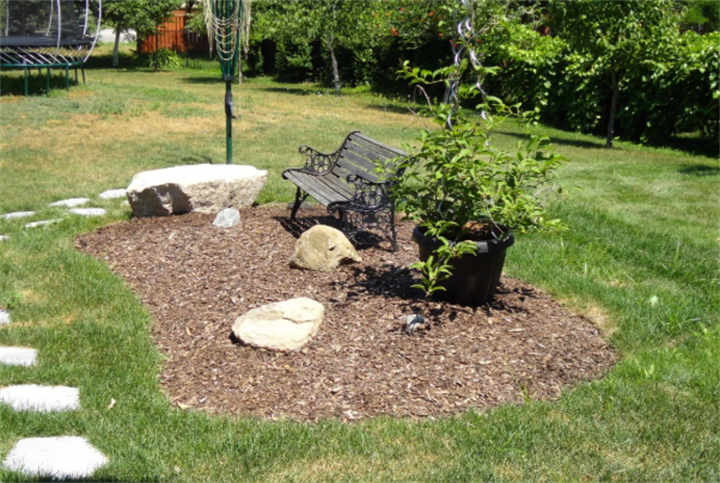
I tend to work with three layers of plants, set at different distances. The first layer goes close to where people sit or walk—grasses that hit around knee height. Blue fescue or lovegrass work beautifully here. They ripple low like gentle waves when the breeze comes through. The second layer sits a meter or two out from the toe of the mound, and it should reach waist- to chest-high. Feather reed grass or ‘Little Bunny’ fountain grass are good choices. They break up the direct line of sight but leave cracks for light and air. The third layer belongs on the mound itself—taller grasses like miscanthus or switchgrass that can top out over six feet once they set seed. They become the backdrop.
Someone standing in the yard will look at the short grasses first. Their gaze will travel upward and outward. By the time it reaches the tall grasses, those are just part of the skyline, not an obstacle sitting in the way.
Transparency matters far more than height. I’ll choose plants you can half-see through, plants that let wind pass through them, over a dense wall of shrubs any day. That kind of wall whispers, “Something’s hiding back there.” That’s the worst possible look. Miscanthus in autumn, backlit and going to seed, turns into a translucent golden screen. The texture alone is worth sitting down with a cup of tea to watch. Even in winter, don’t rush to cut the dried stalks. After a frost, they look sugar-coated, and they’ll stand through till spring without complaint.
If you really want shrubs, remember one number: keep them at least three meters from the absorption field. That’s not a guess. Extension services like PennState and the University of Minnesota have repeated it for years. Past that distance, roots are far less likely to probe into drain pipes. As for deep-rooted trees—willow, poplar, elm, birch—keep them at least six meters away. If your yard is generous, fifteen is even better. Those trees hunt for water. Roots can travel surprisingly far and crack pipes. It happens more often than anyone wants to admit.
Turn the access port into a deliberate focal point
From a design perspective, the access port’s problem isn’t that it’s ugly. It’s that it’s lonely. A grayish round lid floating by itself on the grass, with no relationship to anything around it. The fix isn’t to hide it. It’s to bring it into a small grouping.
My go-to move is simple: place something to one side of the port, maybe twenty to thirty centimeters away, toward the northwest or southeast. This isn’t random. In the Northern Hemisphere, afternoon light comes from the west. An object on the northwest side throws a long, lovely shadow across the grass. That line carries the eye, and the lid gets tucked into the composition instead of sitting there stark and out of place.
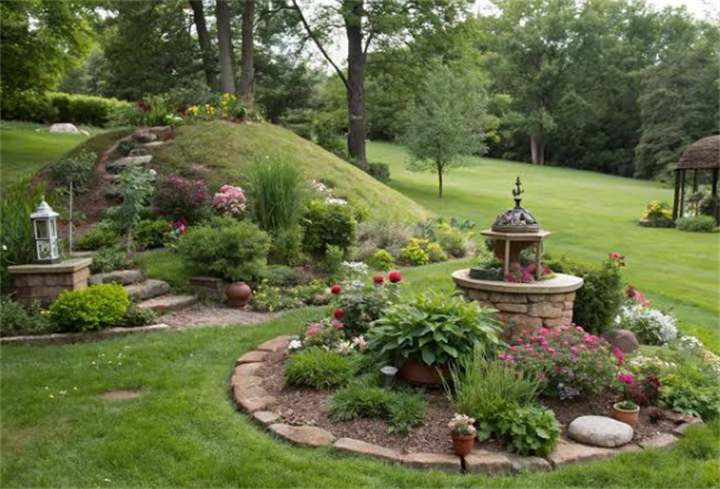
What you place depends on the personality of your yard. A birdbath is a classic. A shallow basin of water, a bird splashing around—suddenly that spot feels animated, and you can even hear the flutter of wings. A sundial is quieter and suits a more restrained style. Over time it gathers a little moss, looking like it’s been there for generations. Lightweight fiberglass fake rocks work well too, as long as you pick a weathered color with a bit of lichen pattern. Shiny new ones just draw more attention. I once saw someone set a hollow beehive-shaped ornament over an access port. It fit perfectly. They planted catmint around it, and when the bees and butterflies came, the whole picture surprised even them.
One caution: after you set something down, try lifting it yourself. A friend once placed a cast-iron sundial. It looked wonderful. Three years later, when the tank needed pumping, nobody could budge it. It took three people and a crowbar, and someone nearly threw their back out. They replaced it with a lightweight sandstone-colored resin sundial that looks just as good.
A vent pipe isn’t a post. It’s a vertical line.
Of all the septic system parts, the vent pipe probably irritates people the most. It sticks straight up, way above the ground, like a misplaced road sign. But if you start seeing it as a vertical line, something shifts. A yard is full of vertical lines already: tree trunks, lampposts, trellises, downspouts. This is just one more.
A trick I reach for often: swallow the pipe inside a tall clump of grass. Plant Italian ryegrass or switchgrass about half a meter directly in front of it. When the grass reaches six feet or so, the pipe disappears from your main viewing angles. You only spot it when you’re right on top of it. For all-around coverage, add another clump behind the pipe. Front and back, and the pipe is gone from nearly every direction.
Another approach, fairly common in European countryside gardens, is to treat the vent pipe as part of a climbing plant structure. Sink three wooden posts around it to form a loose obelisk, then grow clematis or morning glory up it. In summer, leaves and flowers weave around the pipe. In winter, after you cut the vines back, the pipe stands bare again. Each season has its own character. I like this method because it doesn’t pretend the pipe isn’t there. It just gives it a different job, like it was always meant to hold up a cloud of blossoms. Annual vines such as morning glory work especially well. They live one season and never get heavy enough to cause trouble. Come winter, you snip off the dead stems, and it’s tidy.
Play with the slope like it’s land, not a mound
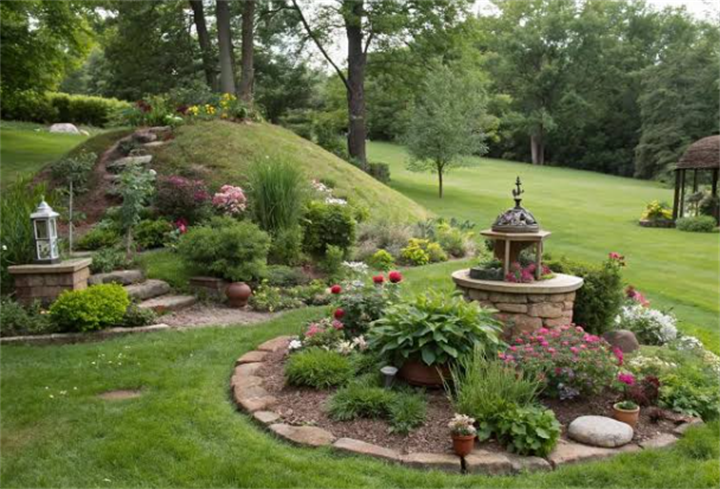
A septic mound usually has a gentle slope, something around a 1:3 vertical-to-horizontal ratio. You can stand on it without feeling like you’ll slide off. That makes it perfect for subtle, rolling landforms. Don’t treat it as a neat geometric plane. Play with slight variations in soil depth. Add a thin layer here, a little more there, to create two or three soft swells. The difference doesn’t need to be dramatic—just twenty or thirty centimeters. Plant with grasses of different heights, and suddenly it looks like a natural knoll that’s always been there.
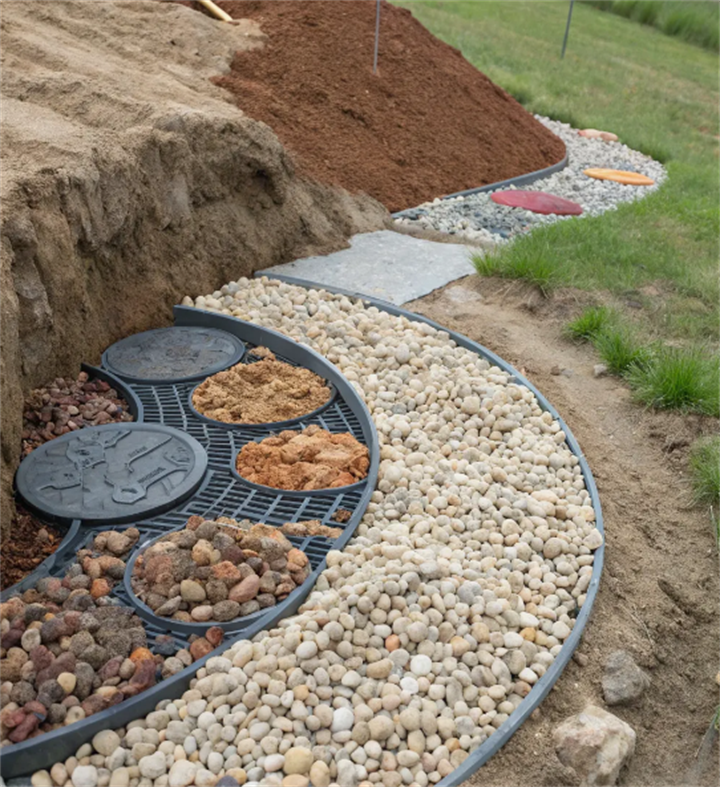
In one yard, I shaped a tiny dry creek bed at the toe of the mound, no more than a meter long. I laid smooth river stones in a shallow curve. There’s no water in it. It’s purely a visual line. The curve carries the eye around the mound and off toward a dogwood in another corner of the yard. Neighbors who visited assumed it was a natural depression. Not one of them connected it to the septic system. When it rains, water slips between the stones and soaks in, giving surface drainage a little helping hand—two benefits in one go.
A wildflower meadow might be the most effortless path
If you honestly don’t want to fuss over plant combinations, a wildflower meadow is worth a long look. Spread about fifteen to twenty centimeters of clean topsoil over the mound—many extension bulletins cite this range; I tend to go for twenty, just to give seeds a deeper start. Then sow a mix of regional wildflowers and fine grasses. Coneflower, black-eyed Susan, and goldenrod blended with something like slender bentgrass. Water deeply a few times to get the roots settled. After that, mostly leave it alone. Cut it back once or twice a year and let the clippings lie where they fall and rot back in.
A meadow like this has a built-in advantage: it’s never supposed to look tidy. Nobody will scrutinize what’s underneath. Year one might look a bit messy. A neighbor might gently ask if you’ve forgotten to mow. Give it another year. The plants sort out their own hierarchy—tall in the middle, shorter toward the edges. When the wind blows, you get layers of rolling waves. A friend in Texas did exactly this. Year one, a neighbor knocked with a sympathetic tone. Year two, when the wildflowers exploded, the same neighbor knocked to ask where to buy the seed.
Things to skip, learned the hard way
Bark mulch and wood chips on a septic mound work against you. They trap moisture, stifle evaporation, and after a summer rain they can get musty and sour. Gravel does the same over time—it compacts the surface and makes it harder for the soil to breathe. The most natural cover is the plants themselves. Grass roots, flower stems, and fallen leaves slowly build a breathable layer that lets the soil do its job. Septic systems need oxygen exchange; many state health department guides underline this. If you absolutely must add something, a whisper-thin layer of chopped straw, no more than three or four centimeters deep, is about all I’d risk.
Don’t water the mound on purpose. One household set up automatic sprinklers over theirs, watering morning and evening. The system stayed saturated, and the odor became noticeably worse. Also, keep roof downspouts pointed well away from the mound. This is easy to miss, especially if you’ve renovated or added a new roofline and changed where the water goes. Double-check it.
I already mentioned deep-rooted trees, but let me share something I saw firsthand. A friend had a willow tree nearly ten meters from his septic line. Everyone thought it was safe. Years later the pipes backed up. When they dug, they found willow roots that had traveled all that distance and coiled precisely around the pipe joints, sniffing for water. The repair bill haunted him for years. Trees have a stronger instinct for seeking water than we give them credit for.
In the end, weaving a septic mound into your yard is really about giving yourself one more reason to stay outside. The second summer after you plant those grasses, one evening you’ll be sitting there. Wind will rustle the miscanthus with a crisp, papery sound. A bird will burst up from the birdbath and flick away. And you’ll realize you haven’t thought the word “mound” in a long while. It’s still there. But it belongs now. It’s part of the place, and you added those strokes of color with your own hands.
FAQs
Can I grow fruit trees or vegetables on the mound?
It’s not recommended. The soil over a septic system can carry pathogens. You wouldn’t want to eat what grows there. Let that patch focus on looking good and breathing well. If you want homegrown fruit, plant the tree at least ten meters away.
Why can’t I just spread bark mulch over the surface?
Bark and wood chips act like a seal, trapping moisture and blocking air exchange. That slows down the septic system’s treatment efficiency. In warm, humid weather, they can mold and create new odor problems.
The access port is still too noticeable, and I don’t want a birdbath. Any other ideas?
Try low, creeping plants around the edge, like creeping thyme or Irish moss. Plant them in a ring around the port. You’re not hiding it—you’re framing it. The soft outline draws the eye toward the border rather than the center.
The vent pipe gets hot in summer. Will climbing plants burn up?
Annual vines like morning glory live one season and only brush against the pipe for a short while; they do fine. Perennials like clematis are safer grown on a separate trellis near the pipe rather than directly on it. Trim back dead growth in winter to keep the pipe clear.
Disclaimer
This article shares personal practice and experience only. It is not professional engineering or horticultural advice. Septic system regulations, soil conditions, and climate vary widely by location. Before making any changes, consult a licensed local professional and your health department, and follow all relevant codes.
References:
[1] PennState Extension. (2023). Landscaping Your Septic System. https://extension.psu.edu/landscaping-your-septic-system
[2] U.S. Environmental Protection Agency. (2021). Homeowner's Guide to Septic Systems (EPA 832-B-21-001). https://www.epa.gov/septic
[3] University of Minnesota Extension. (n.d.). Landscaping over septic drain fields. Retrieved July 24, 2026, from https://extension.umn.edu/septic-systems/landscaping-over-septic-drain-fields
Author Information:
Clara M.
A landscape architect, a mother of three children, now specializes in diagnosing "Why can't people stay in the yard?" Her designs do not aim for being photogenic; they only care about whether you would be willing to spend an extra ten minutes sitting in the evening. She believes that a truly functional backyard will make you forget your phone but remember the wind and the tree shadows of that day.
Recommend:
How to Get Sunlight to Outdoor Seats in Alaskan Winters? — Practical Strategies for Site Selection, Materials, and Wind Protection Weatherproof green outdoor lounge chair protective covers
How to Blend a Septic Mound Seamlessly Into Your Backyard Design

Phoenix Courtyard Design for Extreme Heat: How Adobe and Rammed Earth Walls Stay Cooler
New England’s Bedrock Backyard: When You Can’t Dig Down, Build Up with Raised Beds