Published: July 27, 2026|⏱️12 minutes
By Tommy "The Tally" Kowalski
Reclaimed bricks are cheap and full of character. That makes them attractive for outdoor masonry projects. But using them in a fireplace isn't a simple decision.
Standard clay bricks weren't designed for sustained high heat. Their mineral makeup and firing process are different from refractory (fire) bricks. If you put untested salvaged bricks directly into a firebox, you risk structural failure, cracking, and even the release of harmful substances.
So can you safely use reclaimed bricks in an outdoor fireplace? The answer depends on three layered questions:
Can you identify the risks?
Can you test for them?
Will the mortar work with the brick?
Three Main Failure Modes – Heat, Frost, and Contaminants
When you put old bricks into a hot fireplace, you face three types of risk. Understanding how each works helps you decide which bricks to keep and which to toss.
1. Steam-Driven Cracking
Ordinary building bricks are porous. Most have water absorption rates between 8% and 20%. Some old hand-made bricks are even more absorbent. These pores soak up moisture from rain, ground contact, or humid air.
When you heat a wet brick quickly, the water inside turns to steam. Steam expands about 1,700 times in volume. That creates enormous pressure inside the brick. If the pressure can't escape, the brick explodes or spalls off in layers.
This happens most often on the first fire. There are plenty of documented cases where fire pits or fireplaces built with un-dried reclaimed bricks cracked violently on initial use. Sparks can fly out and ignite nearby material. Even if exact dollar amounts vary, the safety hazard is real.
Drying the bricks thoroughly and heating them slowly reduces the risk—but doesn't eliminate it. There's no simple field test for "dry enough," so you're relying on experience and caution.
2. Strength Loss at High Temperatures
Fire bricks are made with high alumina content—typically 30% to 48% (ASTM C27). This allows them to handle temperatures around 1260°C (2300°F) without breaking down.
Regular building bricks lack that alumina. At around 800°C (1470°F), their strength starts to drop. Over time, with repeated heating and cooling, they lose their load-bearing capacity much faster than fire bricks. Industry data consistently shows that trend, even though exact numbers vary by brick type and test conditions.
I once evaluated a fireplace where the owner used reclaimed red bricks for the inner firebox. After just one winter, the interior showed a network of fine cracks. Corners chipped off. The whole combustion chamber became unstable. The repair bill, according to the owner, was several times what they'd saved on materials. That's one anecdote—not a controlled study—but it's a warning worth heeding.
3. Old Contaminants Released by Heat
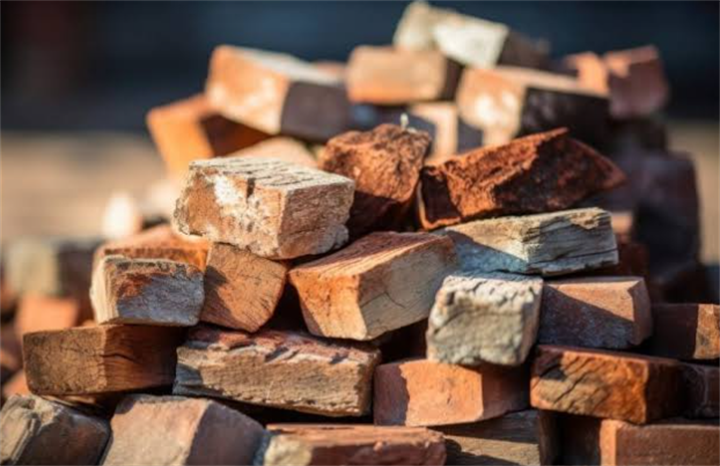
Reclaimed bricks come from all kinds of sources. Some were once coated with paint. Others absorbed coal tar, industrial chemicals, or heavy metals over decades.
At room temperature, those substances stay put. But when the brick gets hot—hundreds of degrees—they can vaporize or decompose. You may not see or smell anything, but harmful gases or particulates could be released.
The U.S. EPA has a test for this—Method 1311, the Toxicity Characteristic Leaching Procedure (TCLP). It's mainly used for waste disposal, not for homeowner screening. But it reminds us of a basic rule: if you don't know where a brick came from, you can't guess what it will release when heated.
If a brick has paint residue, white salt stains, oil spots, or a strange smell, throw it out. That's the simplest way to avoid contamination risks.
Testing – From Field Screening to Lab Numbers
Many people skip testing because it costs money. But think of it this way: you're not testing a single brick. You're buying information about your entire fireplace's structural safety.
First Level: Field Screening
These quick checks don't replace lab tests, but they can eliminate roughly 70% of bad bricks before you pay for analysis.
Tap test: Strike the brick with metal. A clear, ringing sound (like ceramic) means good firing. A dull thud suggests hidden cracks or high porosity – reject it.
Water drop: Put a few drops on the surface. If water soaks in within seconds and leaves a dark stain, the brick absorbs too much water. It won't survive freeze-thaw cycles.
Break test: Crack the brick open and look at the fresh surface. Uniform deep red or brownish-red means it was fired properly. A dark or grey core indicates underfiring – avoid it.
Second Level: Laboratory Testing
For bricks that pass screening and will be used in non-flame zones (like the outer shell), send a few samples to a lab. A basic package—compressive strength, water absorption, and freeze-thaw resistance—typically costs a few hundred dollars, depending on the lab and region. That may sound steep, but compare it to the cost of rebuilding a failed fireplace.
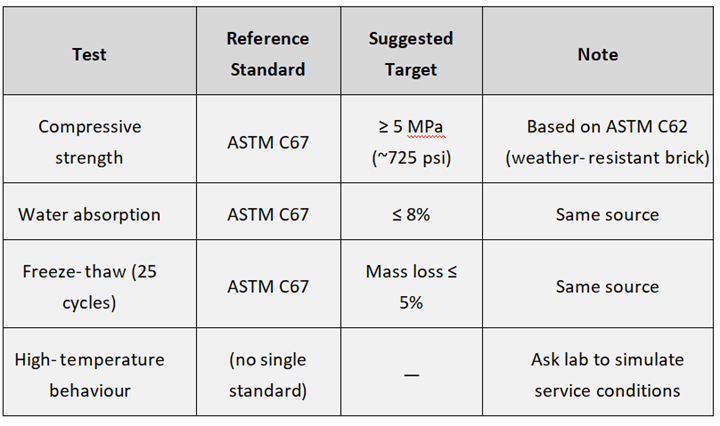
These numbers are borrowed from ASTM C62, which applies to new building bricks, not reclaimed ones. But they serve as reasonable benchmarks.
Important: even if a reclaimed brick meets all these targets, I still don't recommend using it inside the firebox. Why? Because reclaimed bricks have no traceable fire-rating certification. You're betting your safety on a single sample.
Part 3: Mortar Compatibility – The Hidden Weak Link
In many failed fireplaces, the bricks are fine but the mortar joints are shot. This problem gets worse with reclaimed bricks, because their absorption and expansion rates vary widely.
Why Ordinary Mortar Fails
Portland-cement mortar is strong at room temperature. But its hydration products—calcium-silicate-hydrate and calcium hydroxide—start breaking down above about 300°C (570°F). The mortar loses cohesion, turns crumbly, and can't transfer loads between bricks.
Any mortar near flame or hot gases must be refractory mortar. Look for products rated to at least 1093°C (2000°F), consistent with the grading approach in ASTM C199. Refractory mortar costs more per bag, but you don't need much for a typical fireplace. Skimping here is a false economy.
Stiffness Match – A Subtle but Critical Issue
Old bricks have different elastic moduli—some are stiff, others more flexible. If you use a mortar that's much stiffer than the brick, the brick can't expand and contract freely. The mortar locks it in place, and thermal stress concentrates at the brick-mortar interface. Eventually the brick cracks, not the joint.
My standard approach: for old reclaimed bricks, use a lime-rich mortar. Lime mortars are softer, more porous, and more flexible. They allow tiny movements that release stress. I've monitored several fireplaces built with lime mortar and salvaged brick exteriors. After many winters of freeze-thaw and heating cycles, the joints and bricks remain sound. In contrast, similar fireplaces with high-strength cement mortar have required repointing within just a few years.
There's no one-size-fits-all mix for lime mortar. The proportions depend on the specific brick's absorption and strength. This isn't a DIY-friendly job—it needs an experienced mason.
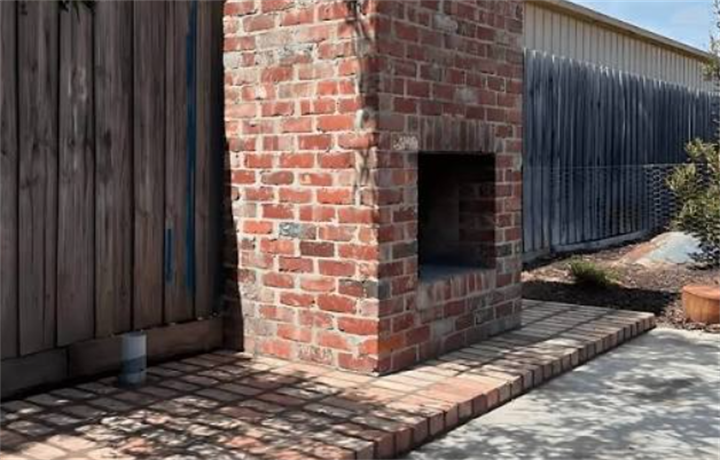
A Zone-Based Strategy – Risk-Appropriate Construction
Given all the above, don't treat reclaimed bricks as all-or-nothing. Divide your fireplace into zones.
Firebox – No Compromises
The firebox (floor, side walls, back wall, and arch) takes the most intense heat and thermal shock. Use only new, certified refractory bricks and refractory mortar here.
Standard firebrick size is roughly 9×4.5×2.5 inches. A small-to-medium outdoor fireplace may need 150–200 pieces. Prices vary by brand and region—check your local suppliers. Never substitute reclaimed bricks in this area.
Outer Shell – Where Reclaimed Bricks Shine
The decorative outer skin, pillars, base, and chimney exterior don't see direct flame. Surface temperatures stay well below 200°C (390°F). This is where reclaimed bricks make sense—provided they've passed the absorption, freeze-thaw, and strength tests described above.
I worked with a client in New England who salvaged bricks from an old textile mill. After lab testing confirmed they were suitable, we used them for the outer shell. The material cost was a fraction of what artificial stone would have cost. After several heating seasons, there's no spalling or cracking. The firebox, meanwhile, was built entirely with new firebrick. This is the model—save money on the look, not on the safety.
Flue – Use a Factory-Made Liner
Don't use ordinary brick—reclaimed or new—for the flue. Flue gases contain moisture, carbon dioxide, and trace acids from combustion. In cold weather, condensation can form a weak acid that slowly eats away at brick and mortar. You might not see the resulting micro-cracks, but they can leak dangerous carbon monoxide into living spaces.
The standard recommendation is a stainless-steel or ceramic flue liner. Cost varies, but it's a small price compared to the risk of gas leakage.
Summary
Reclaimed bricks can be part of a safe outdoor fireplace, but only with clear rules:
Zone by heat exposure – Firebox = new firebrick + refractory mortar. Outer shell = tested reclaimed bricks allowed. Flue = dedicated liner.
Test before you build – Screen in the field, then send samples to a lab. Treat testing as an investment in safety, not an added expense.
Match the mortar – Use refractory mortar near the flame. For the outer shell with old bricks, choose a lime-based mortar with lower stiffness to prevent stress cracking.
Every material choice should tie to a specific function or risk control. Skipping evaluation to save a few dollars today can lead to expensive repairs—or worse—later. That's the math I always come back to.
FAQs
Q1: Can I use reclaimed bricks on the base or hearth if they're not fire-rated?
Yes, provided those areas don't see direct flame (surface temps stay under 200°C). They must still pass freeze-thaw and strength tests. And be sure to install a moisture barrier underneath to stop rising ground water from causing frost damage.
Q2: Is there a quick way to decide if a brick is worth testing?
Clear ring, slow water absorption, and uniform colour are good signs. But that's just a first filter. If the seller says "these lasted 100 years on a building wall," ask for actual absorption and freeze-thaw data before you buy.
Q3: Can I use refractory mortar only on the inner face and regular mortar elsewhere?
No. Heat travels through the whole assembly. All joints that experience high temperature—not just the surface—need refractory mortar. Saving a few bucks here often multiplies repair costs later.
Q4: How do I confirm a brick isn't contaminated?
If the source is unknown or the brick has stains, paint, or odour, reject it. If you really want to use it, ask the supplier for TCLP (EPA Method 1311) results. But my rule: if you can't trace its history, don't put it anywhere that will get warm.
Disclaimer
The information in this article is based on the author's professional experience as a contractor estimator and on publicly available standards as of the publication date. It is for general informational purposes only and does not constitute official engineering or building code advice. All outdoor fireplace projects must comply with local building regulations and be evaluated by licensed professionals on site. Cost figures are illustrative examples based on North American market conditions—actual prices will vary by region, time, brand, and supplier. The author and publisher assume no liability for any loss, injury, or damage resulting from the use of this content.
References
[1] ASTM C27-98 (2013) – Standard Classification of Fireclay and High-Alumina Refractory Brick. (Superseded Sept. 2020; used here for alumina-content ranges.)
[2] ASTM C199-22 – Standard Test Method for Pier Test for Refractory Mortars.
[3] ASTM C67/C67M-25 – Standard Test Methods for Sampling and Testing Brick and Structural Clay Tile.
[4] ASTM C62-21a – Standard Specification for Building Brick (Solid Masonry Units Made from Clay or Shale).
[5] ASTM C270-19a – Standard Specification for Mortar for Unit Masonry.
[6] Brick Industry Association (2006). Technical Notes 19A – Residential Fireplaces, Details and Construction.
[7] U.S. Environmental Protection Agency (1992). Method 1311 – Toxicity Characteristic Leaching Procedure.
Data accuracy notes:
[1] The suggested targets (≤8% absorption, ≤5% mass loss after 25 cycles, ≥5 MPa compressive strength) are taken from ASTM C62 for weather-resistant brick. They are reference points, not mandatory limits for reclaimed brick.
[2] Alumina content (30-48%) comes from ASTM C27. The 300°C threshold for ordinary mortar breakdown is a widely accepted engineering approximation. The 1,700-fold steam expansion figure is basic thermal physics.
[3] All price numbers are illustrative North American examples. Use local supplier quotes for real estimates.
[4] Any statements about specific percentage losses (e.g., "more than half of strength") have been replaced with qualitative descriptions because reliable, single-source test reports could not be verified.
About the author:
Tommy “The Tally” Kowalski
Having worked as a contractor estimator for fifteen years, now he does only one thing: exposing the tricks in the building materials quotations. He doesn't speak politely, but every word is aimed at saving you money. His creed is: "All those seemingly too-good-to-be-true unit prices actually hide hidden fees that are deliberately not written down."
Recommend:
Hot-Dip Galvanized vs. Stainless Steel Hardware for Coastal Decks: A Life-Cycle Cost Analysis
The Real Cost of a Brazilian Teak Deck: 25-Year Maintenance vs. Composite Replacement Cycles
Florida Squall Line Test: Why Your Screen Enclosure Must Resist Wind Suction—Not Just Bugs
The Vanishing "Room" in Open-Plan Homes: A Bug-Proof, Breezy Screened Dining Porch